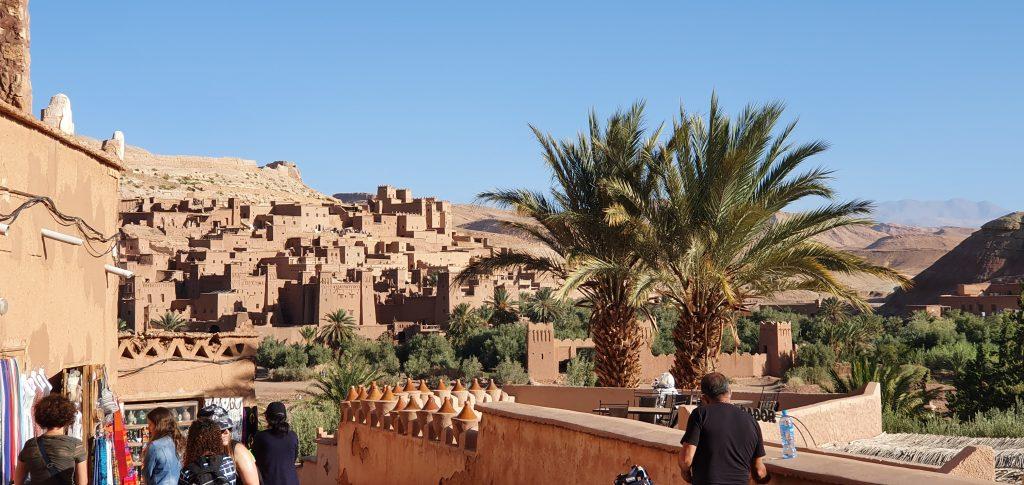
Rising from the arid riverbank of the Ounila Valley like a fortress from another age, Ait Ben Haddou is Morocco’s most dramatic architectural site and one of the most recognizable filming locations in the world. Its towers of red earthen clay, clustered homes climbing the hillside, and fortified granaries have appeared in dozens of Hollywood productions, from Lawrence of Arabia to Gladiator to Game of Thrones. Yet this is not a movie set. It is a real community with a thousand years of history, and it is one of the most rewarding stops on any journey between Marrakech and the Sahara Desert.
This guide covers the history and significance of Ait Ben Haddou, the movies filmed here, practical visiting tips, photography advice, and how to include this extraordinary site in your desert tour itinerary.
The History of Ait Ben Haddou
Origins and Strategic Importance
Ait Ben Haddou is a ksar, a fortified village composed of multiple kasbahs (family compounds) and individual dwellings enclosed within defensive walls. The exact founding date is debated, but the site is believed to have originated in the 11th century, during the Almoravid dynasty that controlled much of North Africa and southern Spain.
The village’s location was strategic. Sitting at a natural crossroads between the Sahara Desert and the city of Marrakech, Ait Ben Haddou controlled a key section of the ancient trans-Saharan trade route. Camel caravans carrying gold, salt, ivory, and enslaved people passed through this valley on their journey between sub-Saharan Africa and the markets of the Mediterranean. The fortified architecture reflects this role: the thick walls, watchtowers, and elevated position were designed to protect the community and its trade goods from raiders and rivals.
Architecture and Construction
The buildings of Ait Ben Haddou are constructed from pise, a technique of rammed earth mixed with straw, lime, and water. The red-ochre color of the structures comes from the iron-rich local soil. Decorative elements include geometric patterns pressed into the wet clay, carved wooden lintels above doorways, and corner towers topped with crenellations.
The ksar follows a hierarchical layout. The most important families lived in the largest kasbahs at the top of the hill, nearest to the communal granary (agadir) at the summit. The granary served as the community’s food reserve, storing grain, dates, nuts, and other provisions that would sustain the village during sieges or droughts. Its elevated, easily defended position reflects the crucial importance of food security in a region where resources were always scarce.
Lower down the hillside, more modest homes housed ordinary families, and the outermost structures served as workshops, stables, and market spaces. The entire village was enclosed within a defensive wall with a single main gate, allowing the community to seal itself off from external threats.
Decline and Preservation
By the mid-20th century, Ait Ben Haddou’s strategic importance had faded. Modern roads bypassed the ancient trade routes, and many families moved across the river to a new village with better access to water, electricity, and transportation. The old ksar was gradually abandoned, and its earthen structures began to deteriorate.
Recognition came in 1987, when UNESCO inscribed Ait Ben Haddou as a World Heritage Site, citing it as an outstanding example of a pre-Saharan earthen architecture settlement. The inscription brought international attention, conservation funding, and, inevitably, tourism. Restoration efforts have stabilized many of the structures, though the challenge of maintaining rammed earth buildings in an arid climate with occasional flash floods is ongoing.
Today, a handful of families still live within the old ksar, maintaining a connection to the site that stretches back generations. Their presence adds an authenticity that purely preserved or reconstructed sites lack.
Hollywood in the Desert: Movies Filmed at Ait Ben Haddou
Ait Ben Haddou’s cinematic career began in the 1960s and has only accelerated since. The combination of spectacular architecture, dramatic natural setting, and proximity to Ouarzazate’s Atlas Studios (the largest film studio in Africa) has made it irresistible to filmmakers.
The Major Productions
Some of the most notable productions filmed at Ait Ben Haddou and the surrounding area include the following.
Lawrence of Arabia (1962): David Lean’s epic used the Moroccan landscape extensively, and Ait Ben Haddou appeared in several scenes. The film’s sweeping desert visuals helped establish Morocco as a go-to location for Hollywood productions set in the Middle East and North Africa.
Jesus of Nazareth (1977): Franco Zeffirelli’s television miniseries used Ait Ben Haddou as a stand-in for Jerusalem and other biblical locations. The aged, Middle Eastern appearance of the architecture required almost no modification.
The Jewel of the Nile (1985): The adventure sequel starring Michael Douglas and Kathleen Turner used Ait Ben Haddou for several key scenes, bringing the site to mainstream audience attention.
The Last Temptation of Christ (1988): Martin Scorsese chose the area for its authenticity in depicting first-century Palestine.
Gladiator (2000): Ridley Scott’s Oscar-winning film used Ait Ben Haddou as the slave market where Maximus (Russell Crowe) is purchased. The scenes of the gladiatorial training compound were also filmed in the area, using the existing architecture supplemented with temporary set construction.
Alexander (2004): Oliver Stone’s epic about Alexander the Great used multiple Moroccan locations, including Ait Ben Haddou, for ancient city scenes.
Kingdom of Heaven (2005): Ridley Scott returned to Morocco for this Crusades epic, once again employing Ait Ben Haddou as a medieval Middle Eastern setting.
Game of Thrones (2013-2015): The HBO series used Ait Ben Haddou as the city of Yunkai, one of the slave cities in Slaver’s Bay that Daenerys Targaryen liberates during seasons 3 through 5. For fans of the show, standing before the ksar and recognizing it as Yunkai is a thrill. The production brought enormous renewed attention to the site.
The Mummy (1999): Stephen Sommers’ adventure film used the Moroccan desert and Ait Ben Haddou for the fictional ancient city of Hamunaptra.
Prison Break (2017): The revival season of the television series filmed portions in and around Ait Ben Haddou and Ouarzazate.
Why Filmmakers Love It
Several factors make Ait Ben Haddou so attractive to film production. The architecture is genuinely ancient and looks authentic on camera without requiring extensive set dressing. The surrounding landscape offers diverse visual backdrops, from river valleys and palm groves to rocky desert and distant snow-capped mountains. Ouarzazate, just 30 kilometers away, provides studio facilities, experienced local crew members, and production infrastructure. Morocco’s government also offers favorable filming incentives and an efficient permitting process.
Perhaps most importantly, Ait Ben Haddou is versatile. It has convincingly doubled for locations across the ancient and medieval world, from Roman North Africa to biblical Palestine to fantasy Essos. Its timeless quality means it does not look like any specific place, yet it looks like everywhere that existed before the modern era.
Visiting Ait Ben Haddou: Practical Tips
Getting There
Ait Ben Haddou is located approximately 30 kilometers northwest of Ouarzazate in southeastern Morocco. If you are traveling between Marrakech and the Sahara, you will almost certainly pass through or near it.
From Marrakech, the drive takes approximately four hours via the Tizi n’Tichka pass over the High Atlas Mountains, one of the most scenic drives in Morocco. The road is well-maintained but winding, with stunning views of terraced valleys, Berber villages, and mountain peaks. Most Sahara desert tours departing from Marrakech include a stop at Ait Ben Haddou as a standard part of the itinerary.
From Ouarzazate, the drive is about 30 minutes along a good paved road.
Entrance and Access
There is no entrance fee to walk through the ksar, though unofficial guides at the entrance may offer their services for a negotiated price. Having a knowledgeable guide significantly enriches the experience, as they can explain the architectural features, point out filming locations, and share the history that the buildings cannot tell on their own.
To reach the ksar from the parking area, you cross the Ounila River. In dry months, this means stepping across sandbags or a shallow ford. During rare periods of higher water, a small footbridge is available nearby. Wear shoes that can get a little wet or sandy.
The path through the ksar climbs steadily uphill over uneven terrain. Comfortable, closed-toe shoes with some grip are important. The walk from the base to the granary at the top takes roughly 30 to 45 minutes at a leisurely pace, with many stops for photographs and exploration.
When to Visit
The best time to visit Ait Ben Haddou is early morning or late afternoon. The morning light casts warm shadows across the earthen walls, highlighting textures and creating depth. Late afternoon light is equally beautiful and has the advantage of illuminating the front face of the ksar, which faces roughly west.
Midday visits are hotter and the light is flat, washing out the colors and reducing the visual drama. If your tour schedule gives you a choice, advocate for a morning arrival.
The site is open year-round. Spring (March through May) and autumn (September through November) offer the most pleasant temperatures. Summer visits are possible but hot, especially during the uphill walk. Winter mornings can be cool but are comfortable for exploration.
How Long to Spend
Most visitors spend one to two hours at Ait Ben Haddou, which is sufficient to walk through the ksar, climb to the top, and take photographs. If you are particularly interested in architecture, history, or photography, three hours allows for a more thorough exploration, including time to sketch, photograph details, and chat with the few remaining residents.
If your schedule allows, consider staying overnight in one of the guesthouses near the site. This gives you access to the golden hour light at both ends of the day and the experience of seeing the ksar illuminated at night, with far fewer visitors around.
Photography at Ait Ben Haddou
Ait Ben Haddou is a photographer’s paradise, offering opportunities ranging from sweeping landscape compositions to intimate architectural details.
The Classic Panoramic View
The most iconic view of Ait Ben Haddou is from across the river, looking up at the full ksar with the hill and granary behind it. This is the image that appears on postcards and in travel guides. The best vantage point is from the elevated area on the approach road, slightly to the south of the main parking area. Morning light is ideal for this shot, when the sun illuminates the eastern face of the structures.
Sunrise and Sunset
Sunrise from the top of the ksar, looking out over the valley, is spectacular but requires either staying overnight nearby or arriving very early. The light at this hour is warm and directional, perfect for dramatic shadows and saturated colors.
Sunset shots work best from the opposite bank of the river, looking back at the ksar as the western light sets the red walls aglow. The sky behind the ksar can produce vivid colors, especially in autumn and spring.
Inside the Ksar
Within the village, the narrow lanes, arched passages, and carved doorways create intimate compositions. Look for patterns created by light filtering through palm frond roofing, the texture of deteriorating plaster revealing the rammed earth beneath, and geometric designs carved into doorframes and lintels.
The view from the top of the granary offers a 360-degree panorama of the surrounding valley, the modern village across the river, and the distant Atlas Mountains. On clear days, the backdrop of snow-capped peaks behind the red-earth village is remarkable.
Equipment Recommendations
A wide-angle lens (24mm or wider) captures the grand scale of the ksar and its setting. A mid-range zoom (24-70mm or equivalent) handles most situations. A telephoto lens allows you to compress the layers of the village from across the river, stacking towers and walls for dramatic effect.
Polarizing filters help manage reflections and deepen blue skies against the red structures. The dusty environment can be tough on gear, so bring a lens cloth and consider a protective filter on your primary lens.
Tips for Better Photos
Avoid placing people in every shot. The architecture speaks powerfully on its own. Look for leading lines: stairways, walls, and pathways naturally guide the eye through compositions. Include foreground elements like palm trees, river stones, or architectural details to add depth to wide shots.
If you want to photograph residents, ask permission first. A smile and a gesture toward your camera will usually get you a clear yes or no. Some residents may ask for a small tip in exchange for posing, which is a reasonable exchange.
Combining Ait Ben Haddou with Your Sahara Desert Tour
Ait Ben Haddou sits on the natural route between Marrakech and the Sahara, making it a logical and rewarding stop on any desert tour.
The Classic Marrakech to Sahara Route
The most popular route from Marrakech to the Erg Chebbi dunes near Merzouga passes directly through the Ait Ben Haddou area. A typical itinerary includes the following progression: Marrakech, over the Tizi n’Tichka pass, Ait Ben Haddou, Ouarzazate, Dades Valley, Todra Gorge, Erfoud, and finally Merzouga and the dunes.
On this route, Ait Ben Haddou is usually visited on the first day, providing a spectacular introduction to the architecture and landscapes of southeastern Morocco. The stop breaks up the long drive from Marrakech and sets the tone for the journey ahead.
Ouarzazate and Atlas Studios
If you have extra time, the nearby city of Ouarzazate is worth a brief visit. Known as the “Hollywood of Morocco,” Ouarzazate is home to Atlas Studios, where many of the productions filmed at Ait Ben Haddou base their operations. Studio tours are available and offer a behind-the-scenes look at film sets, including partially standing sets from various productions.
The Kasbah Taourirt in Ouarzazate city center is another impressive example of traditional Moroccan architecture, featuring elaborate interior decoration and a museum of regional history.
The Valley of a Thousand Kasbahs
Heading east from Ouarzazate toward the Sahara, the road follows the Dades River through a landscape dotted with dozens of kasbahs in various states of preservation. This stretch is known as the Valley of a Thousand Kasbahs (Vallee des Mille Kasbahs), and it offers a continuous visual feast of earthen architecture set against dramatic canyon walls and green palm oases.
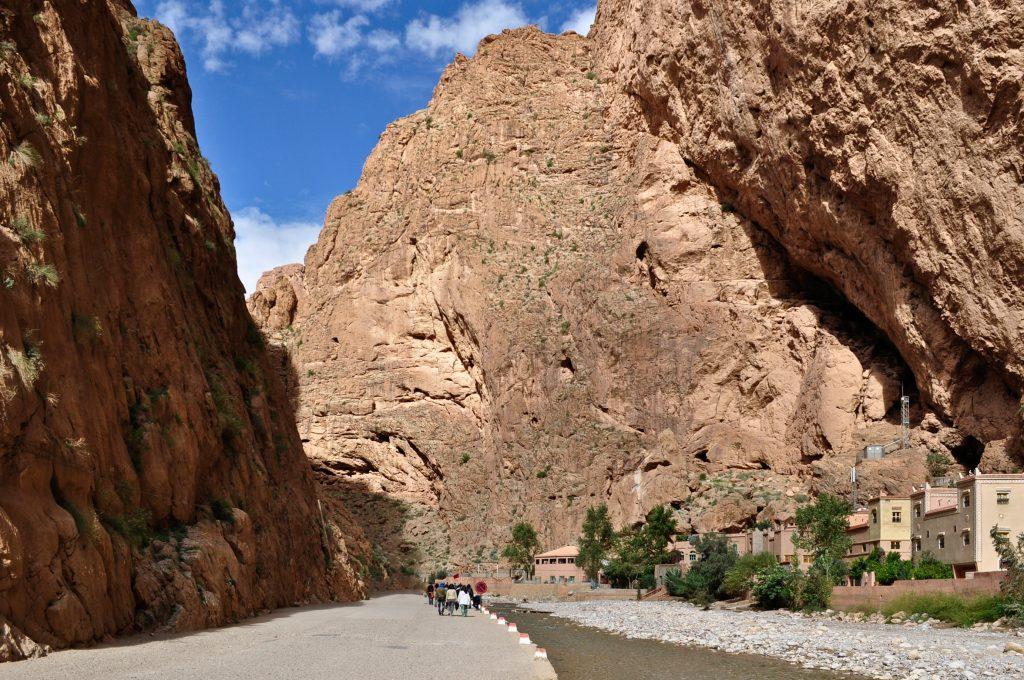
Key stops along this route include the Dades Gorge, where the canyon walls narrow dramatically and the road winds through a series of switchbacks, and the Todra Gorge, where sheer limestone cliffs rise 300 meters on either side of a narrow passage. Both gorges offer excellent hiking opportunities and are standard stops on most desert tour itineraries.
Custom Itinerary Options
If Ait Ben Haddou particularly interests you and you want more than a brief stop, consider building a custom itinerary that includes an overnight stay near the ksar. This allows you to explore at dawn and dusk when the light is best and the crowds are smallest, visit the modern village across the river where local life continues, and take your time with photography and exploration.
Some travelers combine an extended Ait Ben Haddou visit with a day of exploring the surrounding Ounila Valley, which contains several smaller kasbahs and traditional Berber villages that receive far fewer visitors.
The Kasbah Beyond the Movies
While Ait Ben Haddou’s fame rests largely on its cinematic career, the site deserves attention for reasons that go beyond Hollywood.
A Living Heritage
The earthen architecture of Ait Ben Haddou represents a building tradition that stretches back centuries and is still practiced in parts of southeastern Morocco. Rammed earth construction is sustainable, using locally available materials and requiring no industrial inputs. The thermal mass of the thick walls naturally regulates interior temperatures, keeping rooms cool in summer and warm in winter.
This building technology, while ancient, offers lessons for contemporary sustainable architecture. Researchers and architects studying low-carbon construction methods have drawn inspiration from the Saharan ksar model, recognizing that traditional builders solved problems of climate adaptation that modern construction is only beginning to address.
Community and Conservation
The preservation of Ait Ben Haddou depends on a partnership between UNESCO, the Moroccan government, and the local community. Conservation efforts face unique challenges: rammed earth structures require ongoing maintenance, and the traditional repair techniques demand specialized knowledge that is being lost as younger generations move to cities.
Several organizations work to train local craftspeople in traditional construction and restoration methods, creating employment while preserving knowledge. Tourism revenue contributes to these efforts, making your visit part of the conservation equation.
The Living Village
Do not overlook the modern village on the opposite bank of the river. While it lacks the dramatic appeal of the ancient ksar, it is where daily life actually happens. Small shops, a school, restaurants catering to visitors, and the homes of families who once lived within the old walls all line the main road. Walking through the modern village gives context to the old one and offers glimpses of contemporary rural Moroccan life.
Exploring the Area: Activities and Excursions
Beyond the ksar itself, the Ait Ben Haddou area offers several worthwhile activities for visitors with extra time.
Hiking
Trails lead from the ksar into the surrounding hills, offering elevated views of the village and valley. A moderate hike of about an hour takes you to a viewpoint above the ksar that provides a unique perspective rarely captured in photographs. Longer hikes follow the Ounila Valley upstream toward smaller, less-visited kasbahs.
Cooking Classes
Several guesthouses in the area offer Moroccan cooking classes where you can learn to prepare tagine, couscous, and traditional bread using local ingredients. This is a wonderful way to engage with Moroccan culture beyond sightseeing.
Pottery and Crafts
The village has a tradition of pottery making, and you can visit small workshops where artisans produce traditional pieces using techniques passed down through generations. Watching the process from raw clay to finished product is fascinating, and purchasing directly from the artisan supports the local economy.
Final Thoughts
Ait Ben Haddou is more than a photogenic ruin or a movie set. It is a testament to the ingenuity and resilience of the communities that built it, a window into a chapter of history when trade routes connected the Sahara to the Mediterranean, and a place where the intersection of culture, architecture, and landscape produces something genuinely extraordinary.
Whether you are a film enthusiast hoping to stand where Russell Crowe was sold into slavery, a history lover fascinated by trans-Saharan trade, an architecture student studying earthen construction, or simply a traveler who appreciates beauty, Ait Ben Haddou delivers. And as a stop on your journey into the Sahara, it sets the stage magnificently for the dunes that await.
Ready to include Ait Ben Haddou in your Sahara adventure? Explore our desert tours that pass through this extraordinary site, or contact our team to plan a custom journey that gives you the time and access to experience it fully.