The Sahara Desert is one of the most photogenic landscapes on earth. The endless sweep of golden dunes, the interplay of light and shadow across sinuous crests, the vast night sky blazing with stars, and the timeless scenes of camel caravans silhouetted against fiery sunsets create opportunities for images that are genuinely extraordinary. Yet the desert also presents unique challenges that can frustrate unprepared photographers. Harsh light, extreme contrast, blowing sand, and the sheer scale of the landscape all demand a thoughtful approach.
Whether you are shooting with a professional DSLR, a mirrorless camera, or simply your smartphone, the principles of great desert photography remain the same. This guide covers everything you need to know to capture stunning images during your Sahara adventure, from technical camera settings and composition strategies to practical advice on protecting your gear and making the most of the desert’s magical light.
Understanding Desert Light: The Key to Everything
Light is the single most important factor in desert photography, and the Sahara offers some of the most dramatic lighting conditions you will encounter anywhere. Understanding how light behaves in the desert and timing your shooting around the best conditions will make a greater difference to your images than any piece of equipment.
The Golden Hours: Sunrise and Sunset
The golden hours, roughly the first and last hour of sunlight each day, are when the desert reveals its full beauty. During these periods, the low-angle sunlight rakes across the dune surfaces at oblique angles, casting long shadows that emphasize the flowing shapes and textures of the sand. The light itself takes on warm golden and amber tones that make the dunes seem to glow from within.
Sunrise in the Sahara is particularly special. The air is cool and still, the sand is unmarked by footprints, and the transition from the blue-grey pre-dawn light to the first golden rays creates a rapidly changing palette that offers new compositions every few minutes. Most desert camps organize guided sunrise excursions to the top of nearby dunes, and this is time you should absolutely prioritize for photography.
Sunset is equally magnificent but with a different character. The light is warmer, the shadows are longer, and the sky often develops vivid bands of orange, pink, and purple as the sun drops below the horizon. The period just after sunset, known as the blue hour, provides a cool, even light that is beautiful for wide landscape shots and portraits.
Midday Challenges
The middle of the day, roughly from 10 a.m. to 3 p.m., presents the most challenging conditions for desert photography. The sun is high and harsh, shadows are short and unflattering, and the intense light washes out the subtle textures and colors of the sand. The heat shimmer that rises from the ground can also cause distortion in distant subjects.
This does not mean you should put your camera away entirely during midday. The high contrast of midday light can work well for abstract compositions, close-up details of sand patterns, and black-and-white photography where you want strong graphic shapes. It is also a good time for photographing the interior of tents and camp scenes, where the filtered light creates interesting patterns.
Overcast and Hazy Conditions
While rare in the Sahara, overcast skies and hazy conditions do occur, particularly in spring when wind-blown dust can create a soft, diffused light. This light is excellent for portraits, as it eliminates harsh shadows on faces, and for capturing the subtle color gradients of the dune surfaces.
Composition Techniques for Desert Landscapes
The Sahara’s vastness can be both inspiring and overwhelming from a compositional standpoint. The endless repetition of dunes and sand can make it difficult to create images with a clear focal point and a sense of depth. Here are the most effective composition strategies for desert landscapes.
Leading Lines and S-Curves
Dune ridges are natural leading lines that draw the eye through the frame. The sinuous S-curves formed by wind-shaped crests are among the most elegant compositions available in the desert. Position yourself so that a dune ridge enters the frame from a corner and curves toward the center or opposite corner, creating a flowing path for the viewer’s eye to follow.
The sharp shadow lines that form along dune crests during golden hour are particularly effective as leading lines. Look for positions where light and shadow create parallel or converging lines that add depth and structure to your composition.
Scale and Human Elements
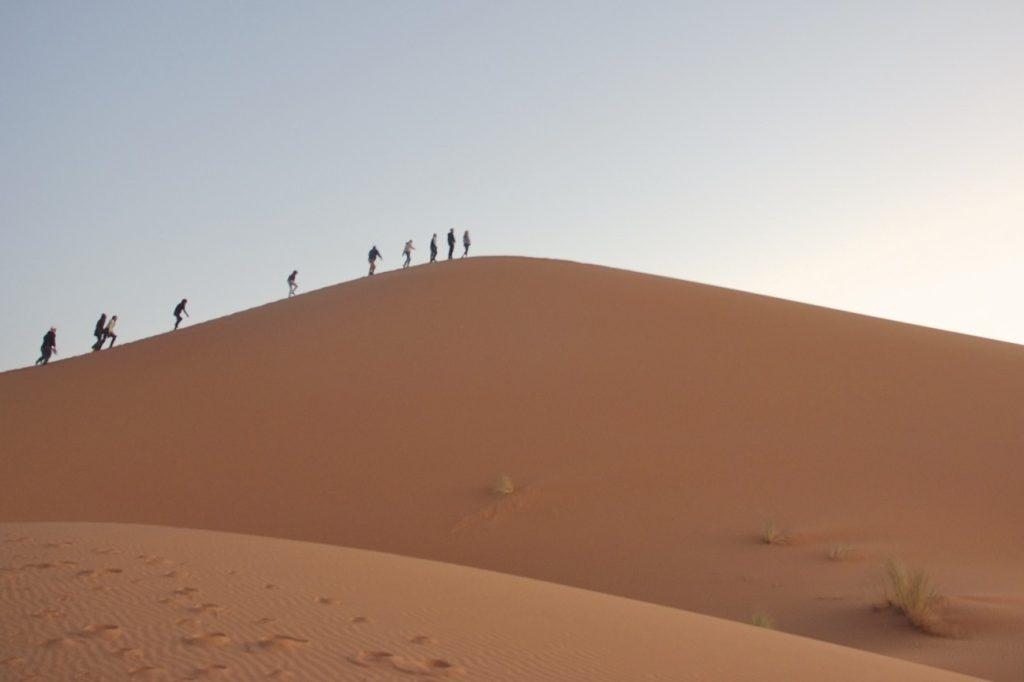
One of the biggest challenges in desert photography is conveying the immense scale of the landscape. A photograph of dunes without any reference point can look like a close-up of a sand ripple or a vast landscape; the viewer has no way to tell. Including a human figure, a camel caravan, or even a set of footprints immediately establishes scale and transforms the image.
A small human figure on a distant dune ridge, for example, creates a powerful sense of the desert’s enormity. A camel caravan crossing the middle ground adds both scale and narrative. Footprints leading away from the camera into the distance create depth and invite the viewer into the scene.
When shooting with people in the frame, pay attention to their placement. Positioning a figure at the intersection of thirds, on a ridge line, or silhouetted against the sky creates the strongest visual impact.
Minimalist Compositions
The desert naturally lends itself to minimalist photography. Look for compositions that reduce the scene to its essential elements: a single dune crest against a clear sky, a lone tree or shrub against smooth sand, or the simple geometry of light and shadow on a dune face.
Negative space is your ally in the desert. Allowing large areas of sand or sky to dominate the frame creates a sense of openness and solitude that captures the essence of the Saharan experience. These stripped-back compositions often produce the most powerful and memorable images.
Texture and Detail Shots
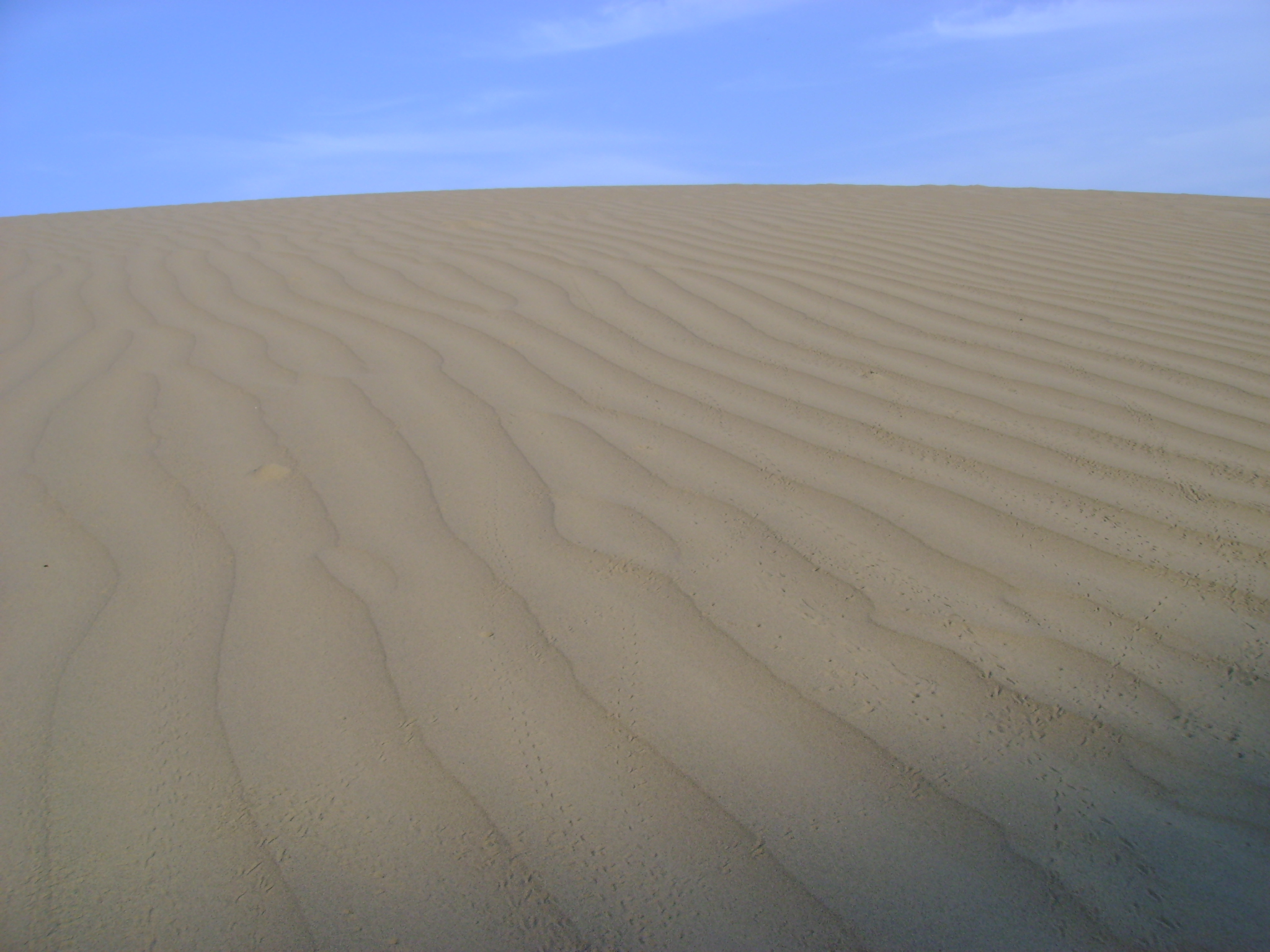
Do not overlook the small-scale wonders of the desert. The wind creates intricate patterns in the sand that change constantly, ripples, waves, and crescent-shaped ridges that are fascinating at close range. Desert plants, insects, and animal tracks all provide compelling subjects for detail photography.
For texture shots, get low and use a narrow aperture (f/11 to f/16) to ensure sharpness across the frame. Side lighting from the golden hours emphasizes these patterns most effectively, with the tiny shadows cast by each sand grain creating a three-dimensional quality.
Camera Settings for Desert Photography
Exposure and Metering
Desert scenes can fool camera metering systems because of the high reflectivity of sand. Your camera’s meter will tend to underexpose desert scenes, trying to render the bright sand as a middle grey. The result is images that look dull and lifeless.
The simplest correction is to add positive exposure compensation, typically between +0.7 and +1.3 stops, depending on conditions. Check your histogram regularly; the sand tones should fall in the right third of the histogram without clipping the highlights. Spot metering or center-weighted metering can also help, as they are less influenced by large areas of bright sand at the edges of the frame.
For sunrise and sunset shots where the sky is much brighter than the foreground, consider using graduated neutral density filters or bracketing your exposures for later blending in post-processing.
White Balance
Auto white balance often performs well in the desert, but for the most accurate and consistent results, consider setting your white balance manually. A Daylight or Sunny preset works well for midday shooting, while a Cloudy or Shade preset can enhance the warm tones of golden hour light. If you shoot in RAW format (which is strongly recommended), you can adjust white balance precisely during post-processing.
Aperture and Depth of Field
For sweeping landscape shots, use a narrow aperture between f/8 and f/16 to ensure sharpness from foreground to background. Focus approximately one-third of the way into the scene for optimal depth of field, or use hyperfocal focusing if your lens supports it.
For portraits and subject-focused shots, a wider aperture (f/2.8 to f/5.6) will separate your subject from the background with a pleasing blur. The smooth, uniform sand of the desert makes an excellent background for portraits at wide apertures.
Shutter Speed Considerations
In bright desert conditions, shutter speed is rarely a concern for landscape photography, as there is plenty of light available. However, if you are photographing blowing sand, a fast shutter speed of 1/1000 second or higher will freeze the individual grains in motion, while a slower speed of 1/30 to 1/125 second will create a sense of movement and energy.
For camel caravan shots, a shutter speed of 1/250 to 1/500 second will typically freeze the movement while still looking natural. For creative motion blur effects, experiment with slower speeds and a steady tripod.
Night Sky and Astrophotography in the Sahara
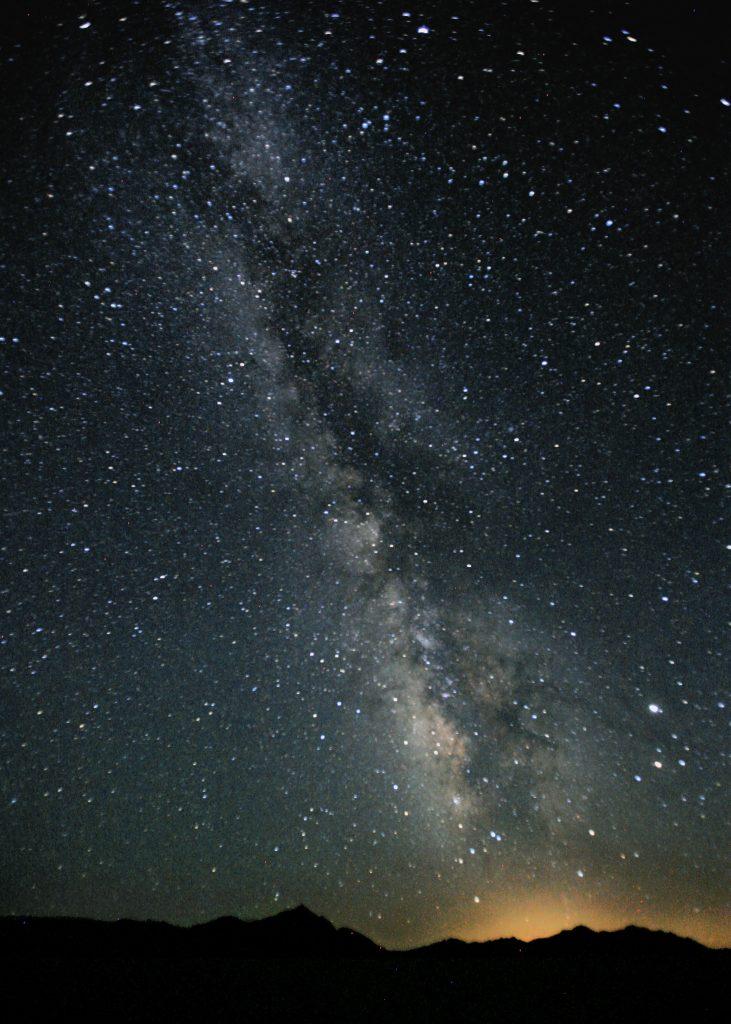
The Sahara offers some of the best conditions for night sky photography anywhere in the world. With virtually no light pollution, the night sky reveals the Milky Way, countless stars, and deep-sky objects with remarkable clarity. Capturing this requires specific techniques and some additional equipment.
Essential Gear for Night Photography
A sturdy tripod is absolutely essential for night sky photography. You will be using long exposures of 15 to 30 seconds, and any camera movement will result in blurred stars. A remote shutter release or your camera’s built-in timer will help avoid shake when triggering the shutter.
A fast wide-angle lens is ideal. A focal length between 14mm and 24mm (on a full-frame sensor) with a maximum aperture of f/2.8 or wider will gather the most light and capture the widest expanse of sky. Kit lenses with maximum apertures of f/3.5 or f/4 can still produce good results but will require higher ISO settings.
Camera Settings for Star Photography
For sharp star images without visible trailing, use the 500 rule: divide 500 by your focal length to determine the maximum exposure time in seconds before stars begin to streak. For example, with a 20mm lens, the maximum exposure is 25 seconds.
Set your lens to its widest aperture (f/2.8 or wider if possible) and your ISO to between 1600 and 6400, depending on your camera’s noise performance. Focus manually on a bright star using live view at maximum magnification, as autofocus will struggle in the dark.
Shoot in RAW format to retain maximum detail and flexibility in post-processing. The Milky Way core is visible in the Sahara sky from approximately March through October, with the best visibility between May and September when it arcs high overhead.
Composing Night Sky Images
The most compelling night sky photographs include an interesting foreground element that anchors the image and provides context. In the desert, this might be a dune silhouette, a camp tent with warm interior light, a camel resting on the sand, or the figure of a person gazing upward.
Position the Milky Way as a strong diagonal element in your frame, ideally arcing from one corner toward the opposite side. Including the horizon creates a sense of place, while shooting straight up captures the densest star fields.
Star Trails
For a different approach, long-exposure star trail photographs capture the rotation of the earth as circular streaks of light across the sky. These require exposures of 30 minutes to several hours, achieved either through a single very long exposure or by stacking many shorter exposures in post-processing. The stacking method is preferred as it reduces noise and allows for more flexibility.
Point your camera toward Polaris (the North Star) to capture circular trails centered on the celestial pole, or aim south for trails that arc across the frame in parallel curves.
Phone Photography: Making the Most of Your Smartphone
Not every traveler carries a dedicated camera, and modern smartphones are capable of producing excellent desert images with the right technique. Here are tips specifically for smartphone photographers.
Maximizing Phone Camera Performance
Use your phone’s HDR mode for landscape shots. This feature captures multiple exposures and combines them, helping to manage the extreme contrast between bright sand and darker sky or shadow areas. Most modern phones handle HDR processing very effectively.
Clean your lens before every session. Desert sand and dust accumulate on phone lenses quickly and can cause hazy, low-contrast images. A microfiber cloth kept in a pocket is essential.
Use the exposure lock feature (available on most phones by long-pressing on the screen) to control exposure in tricky lighting conditions. Tap on the bright sand to expose for highlights, or tap on shadows to reveal detail in darker areas.
Night Mode on Phones
Modern smartphone night modes have improved dramatically and can capture surprisingly good images of the night sky. While they will not match a dedicated camera with a fast lens, they can record the brighter stars and the general shape of the Milky Way. Use a phone tripod or prop your phone against a stable surface to keep it steady during the multi-second exposure that night mode requires.
Panorama Mode
The desert’s vast horizons are ideal for panoramic images. Use your phone’s panorama mode to capture sweeping views that convey the scale and openness of the landscape. Move slowly and steadily for the best results, and keep the horizon level throughout the sweep.
Protecting Your Gear in the Desert
Sand is the enemy of cameras and lenses. Fine Saharan sand can infiltrate zoom mechanisms, clog focus rings, and scratch lens surfaces if you are not careful. Taking precautions to protect your equipment will save you from expensive repairs.
Sand Protection Strategies
When you are not actively shooting, keep your camera in a sealed bag. A simple ziplock bag works in a pinch, but a dedicated camera rain cover or a padded camera bag with tight closures is better. Never change lenses in windy conditions; the brief moment when the sensor is exposed is enough for sand to enter and cause damage.
Bring lens cleaning supplies including a blower brush (the most important tool for removing sand without scratching), lens tissues, and a microfiber cloth. A UV or clear protective filter on your lens provides an inexpensive layer of protection for the front element.
Battery and Memory Management
Heat accelerates battery drain, and cold desert nights can reduce battery capacity significantly. Carry at least two fully charged batteries and keep spares in an inside pocket close to your body to maintain their temperature. Memory cards are inexpensive; bring more than you think you need and shoot generously.
Making the Most of Your Desert Photography Experience
The best desert photographs come from patience, preparation, and a willingness to wake up early and stay out late. Here are final tips for maximizing your photographic results during a Sahara trip.
Plan your compositions in advance by scouting locations during the afternoon when the light is less favorable. Identify the dune ridges, curves, and subjects you want to photograph, then return during golden hour when the light transforms the scene.
Embrace the changing conditions. No two sunrises or sunsets in the desert are the same, and unexpected weather events like dust haze, high-altitude clouds, or sudden wind can create dramatically different and often more interesting images than clear-sky conditions.
Take your time. The impulse to snap quickly and move on is strong, especially when the light is changing rapidly, but the best images come from careful observation and deliberate composition. Spend time looking at the scene with your eyes before you raise the camera.
When you book a desert tour with Duna Daurada, our guides are happy to help you find the best photography locations and can adjust the itinerary to accommodate sunrise and sunset shooting sessions. For dedicated photographers, we can create custom itineraries that prioritize photographic opportunities, including extended time in the dunes, visits to photogenic locations, and timing around optimal lighting conditions.
Bringing Your Images to Life: Post-Processing Tips
Even the best in-camera images benefit from thoughtful post-processing. For desert photographs, a few key adjustments can transform a good image into a great one.
Increase the warmth slightly to enhance the golden tones of the sand. Boost clarity or texture to emphasize the fine patterns and ripples in the dune surfaces. Adjust the shadows and highlights to recover detail in both bright sand and darker shadow areas. A subtle vignette can draw the eye toward the center of the frame and away from the edges.
For night sky images, increase the contrast and clarity to make stars pop against the dark sky. Adjusting the white balance toward cooler tones can enhance the blue and purple hues of the Milky Way. Noise reduction is usually necessary for high-ISO night shots, but be careful not to over-smooth the image at the expense of star detail.
Your Desert Portfolio Awaits
The Sahara Desert is a place that demands to be photographed. Its beauty is so extraordinary, so unlike anything in our daily experience, that the camera becomes an essential tool for processing and preserving what we see. Whether you return home with a collection of professional-grade landscape images or a phone full of snapshots that capture the feeling of being there, your Sahara photographs will be among the most treasured images you ever take.
Explore our desert experiences and start planning a trip that gives you the time, access, and guidance to capture the Sahara at its most magnificent. The golden dunes, the infinite stars, and the timeless beauty of the desert are waiting for your lens.